
“Mar-a-Lago Face,” Susan Dell, and the Case for Doing Less

On October 7, Susan Dell stood behind President Trump next to her husband, Michael Dell, to talk about child savings accounts. Within hours, nobody was talking about savings accounts.
The internet wanted to know what happened to Mrs. Dell’s face. Countless viral TikToks, Reddit Threads, and tabloid “experts” weighing in. The hypotheses bandied about include eyelid surgery, filler, surgical facelift, or all three. One clinic put a price on all the work in their blog ≥ $100,000.
The photos were admittedly jarring, and the internet didn’t hold back. Dell hasn’t said anything about this and she certainly doesn’t deserve to be dehumanized or demonized. But you don’t need a diagnosis to see why it struck a nerve. It’s exactly the result my patients are terrified of.
So let’s talk about how faces end up here – and how to avoid it.
What “Mar-a-Lago face” actually means
The phrase is, obviously, named after President Trump’s Palm Beach club, and it’s become shorthand for the “heavily treated” look common in his orbit: overfilled lips and cheeks, a tight, pulled mid-face, and eyes that look startled instead of rested. Surgeons have told reporters they’re fielding requests modeled on Kristi Noem, Matt Gaetz, Kimberly Guilfoyle and others. None of them has confirmed specific procedures, and the look itself isn’t new – a generation ago, people called it “Housewives face.”
Washington, D.C. plastic surgeons told Axios last year that some new clients now want to look like they’ve had something done. One surgeon described turning patients away who asked for more filler on top of already-treated faces. She called it “filler blindness” – losing sight of what a normal face looks like.
Wanting to look less tired is perfectly reasonable. The trouble starts with the tools most people reach for…
Cut and fill: why it goes wrong
I’ve spent my career arguing that you shouldn’t cut the cornea when you don’t have to. The same logic applies around the eyes.
Most aesthetic work does one of two things. It adds volume (filler, fat transfer) or removes and tightens tissue (eyelid surgery, facelifts). Both can look great in skilled, restrained hands. Both are also where things go sideways:
Filler migrates, layers up over years, and can leave the puffy, overfilled look people now call “pillow face.”
Upper eyelid surgery removes skin and sometimes fat. Take too much and the lid hugs the eyeball, which reads as hollow or surprised. You can’t put it back.
Facelifts pull tissue tighter. Pull too far and the face looks windswept rather than younger.
None of these address the reason faces sag in the first place. After 30, muscle mass can decline 3–5% per decade. The muscles that hold up your cheeks and lower lids weaken, and everything above them settles. Filling or cutting the surface doesn’t rebuild that foundation.
Start with the muscle instead
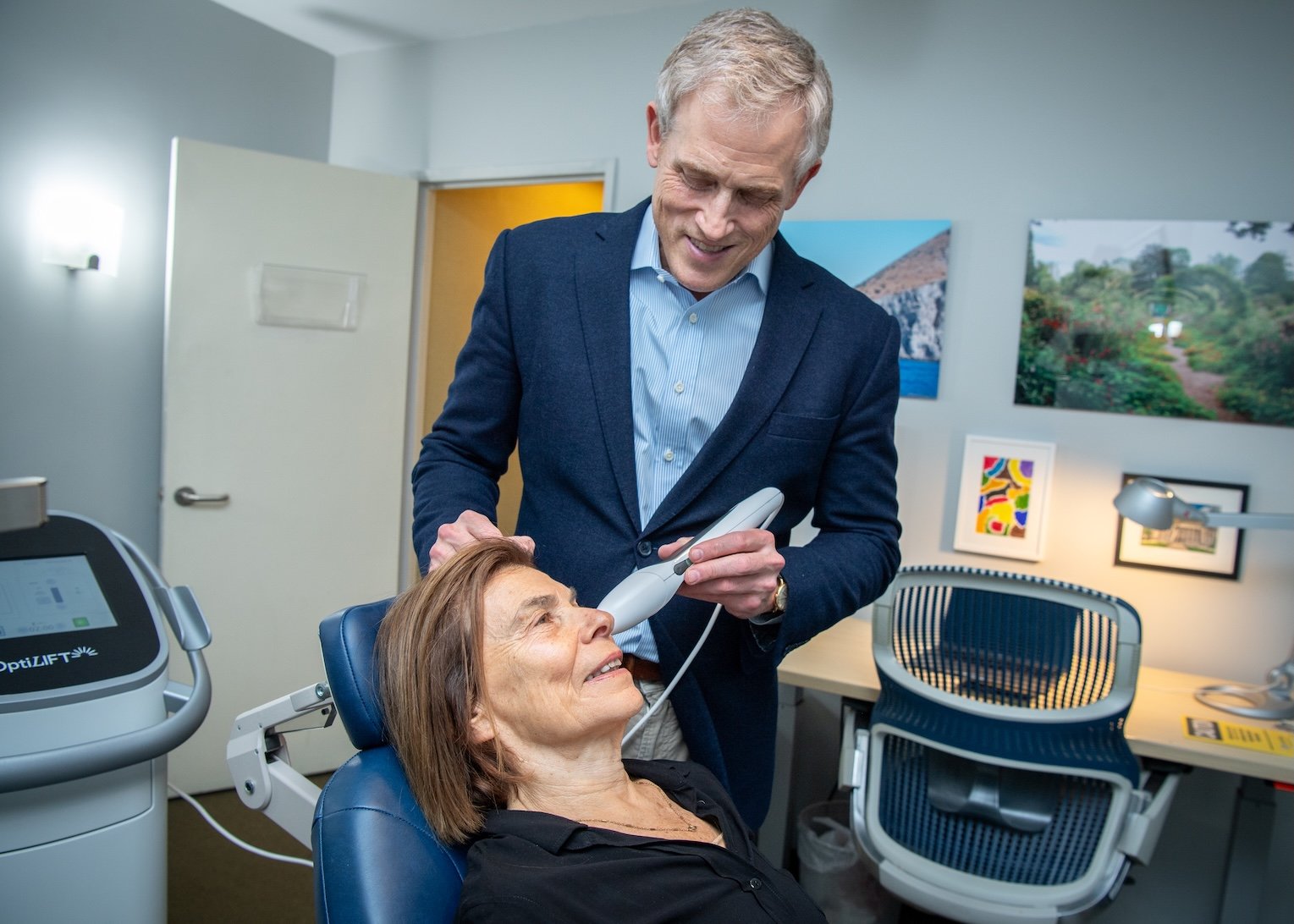
That’s why we added triLIFT to our Upper East Side practice. It works from the bottom up. Dynamic Muscle Stimulation contracts the facial muscles end to end, harder than you can voluntarily, to rebuild lost tone. Radiofrequency and ultra-fine microneedling then firm the skin over them by stimulating your own collagen.
Nothing gets injected, nothing gets cut, and nothing foreign is left behind. Sessions are 20 to 30 minutes long, and you go straight back to your day. A series is typically four-to-six weekly treatments.
The evidence around the eyes is strong. In a peer-reviewed study of the same muscle-stimulation technology, the share of patients with lower lid laxity dropped by roughly 77% one month after treatment. It’s the same principle behind OptiLIFT, which we already use to strengthen the eyelids and improve blinking.
| Filler | Eyelid surgery / facelift | triLIFT™ | |
|---|---|---|---|
| What it does | Adds volume | Removes or tightens tissue | Tones muscle, firms skin |
| Downtime | Bruising and swelling for days | Typically 1–2+ weeks | None |
| Reversible? | Partly – hyaluronic acid filler can be dissolved | No | Results fade gradually without maintenance |
| What overdoing it looks like | Puffy, “pillow face” | Hollow, pulled or startled | Hard to overdo – it’s your own tissue |
The tradeoff is that triLIFT results build gradually and need periodic maintenance, the way any trained muscle does. I see that as a feature. You stay in control of the result, and the most anyone says is that you look well rested.
Where surgery still makes sense
I’m not anti-surgery. If heavy upper lids are blocking your vision, an eyelid lift can be medically necessary, and a good oculoplastic surgeon is the right call. Some patients with significant laxity will get more from a facelift than from any device.
But most people who walk into my office don’t need either yet. They’re in their 40s, 50s or 60s, they look more tired than they feel, and they’ve watched enough viral before-and-afters to be nervous. For them, it makes sense to try the non-surgical route first. You can always do more later. You can’t easily undo a scalpel or a syringe.
It’s also why I think the area around your eyes belongs with an eye doctor, not just a med spa – the same reason I make the case for getting an IPL photofacial from an ophthalmologist.
Want to look rested without looking “done”? Book a consultation at our Upper East Side office and we’ll talk honestly about what triLIFT can and can’t do for you.