
Dry Eye Syndrome Self-Assessment Quiz
Dry Eye Discomfort & Best Treatment Survey
This should only take two minutes. Every question you answer below carries points – the higher your total, the more likely you'll benefit from in-office treatment with OptiLIGHT IPL and OptiLIFT rather than drops and at-home habits alone. Answer everything, then tap See my score. Print your results and bring them to your appointment.
Nothing is submitted or saved. Your answers stay on your device.
Eye Health Assessment
1. How frequently do you experience any of the following dry eye symptoms? (Select one option for each)
| Never | Occasionally | Frequently | Constantly | |
|---|---|---|---|---|
| Burning or stinging | ||||
| Grittiness / foreign body sensation | ||||
| Blurred vision that improves with blinking |
2. On average, how many hours per day do you spend looking at digital screens? (computer, phone, tablet)
3. Do your eye symptoms worsen in any of these situations? (Check all that apply)
Symptoms that build through the day are a classic sign of Meibomian Gland Dysfunction. Dr. Moskowitz explains how he treats it in OptiLIGHT IPL vs. LipiFlow.
Facial Aesthetic Concerns
4. Which areas around your eyes concern you most? (Check all that apply)
5. Have you noticed any of the following skin changes? (Check all that apply)
6. What skincare products do you currently use around your eyes? (Check all that apply)
Sun spots and uneven tone respond to the same IPL light used for dry eye. Read why a photofacial from an MD differs from a med spa.
7. Rate your level of concern about each of the following.
1 = Not concerned · 5 = Very concerned
| 1 | 2 | 3 | 4 | 5 | |
|---|---|---|---|---|---|
| Overall eye comfort | |||||
| Facial pigmentation | |||||
| Fine lines and wrinkles | |||||
| Under-eye appearance |
Your score
Dry eye symptoms: 0 / 36 · Aesthetic concerns: 0 / 24
Your symptoms are mild or occasional. At this level, simple habits done consistently usually do the job:
- Preservative-free artificial tears, used on a schedule – not only when your eyes already feel dry
- Warm compresses and lid hygiene to keep the oil glands in your lids flowing
- Blinking exercises and the 20-20-20 rule at screens: every 20 minutes, look 20 feet away for 20 seconds
- A humidifier, and less direct air from vents and fans
- Prescription anti-inflammatory drops if symptoms hang on
If you're still uncomfortable after a few weeks, or your score climbs, it's time for an exam.
Your symptoms are more than occasional – often a sign that the Meibomian glands in your lids aren't producing a healthy oil layer. Drops soothe the surface, but they don't touch the inflammation driving Meibomian Gland Dysfunction (MGD).
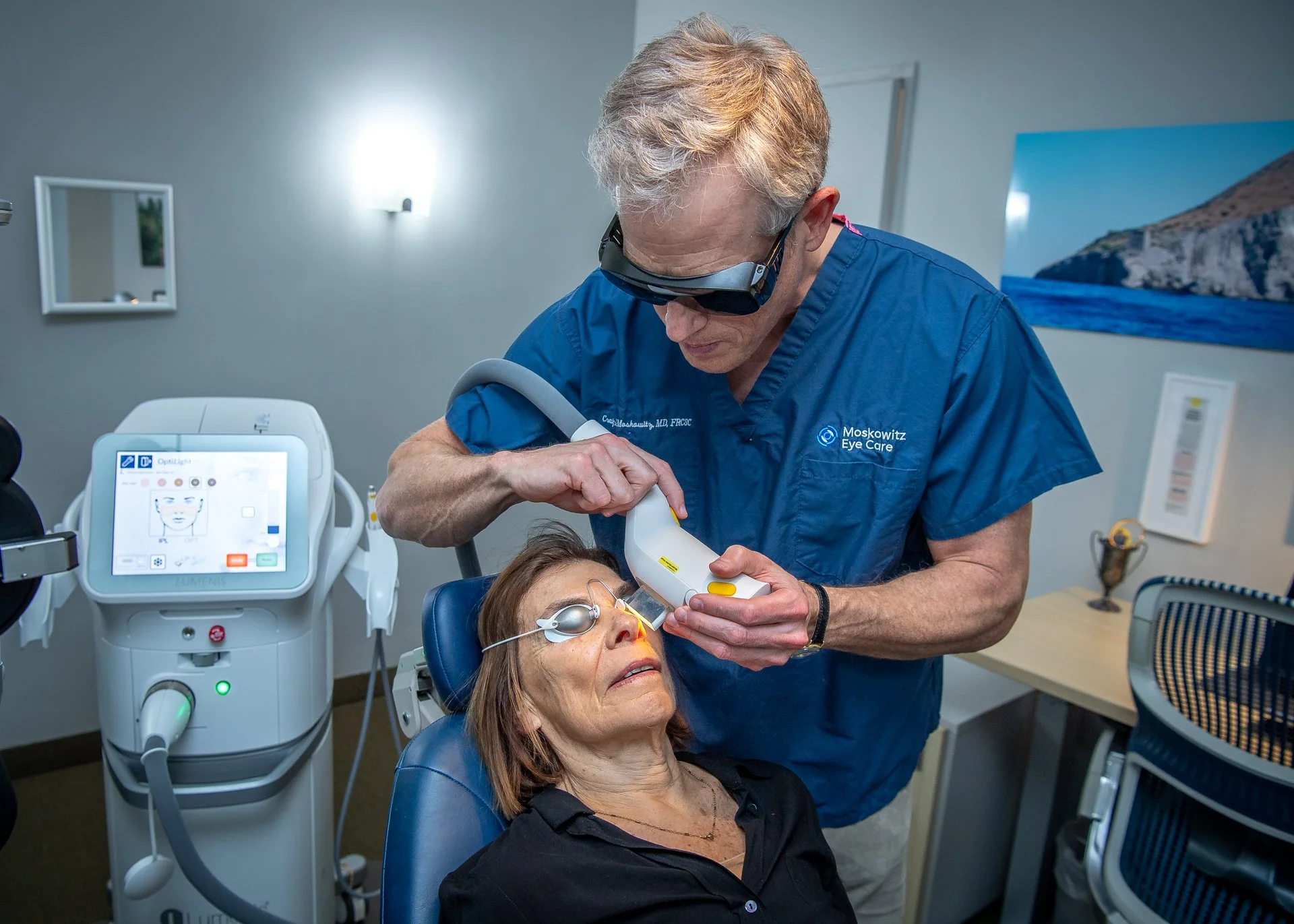
OptiLIGHT IPL treats that upstream cause – inflammation, Demodex and rosacea-related changes along the lid margin. Keep up the at-home basics (scheduled artificial tears, warm compresses, screen breaks), and book an evaluation to see whether OptiLIGHT makes sense now.
Your answers lean toward the skin around your eyes – pigmentation, texture, fine lines. Creams and serums only reach so deep.
OptiLIGHT IPL treats sun spots, redness and uneven tone, and the same light calms the lid inflammation behind dry eye – so it's worth an evaluation even if your eyes feel fine today. If firmness and fine lines are the bigger concern, ask about OptiLIFT at the same visit.
Read more: OptiLIGHT IPL vs. LipiFlow
Your score puts you in the range where combined in-office treatment does the most.
- OptiLIGHT IPL calms the inflammation behind MGD – and treats sun spots, redness and uneven tone in the same sessions.
- OptiLIFT uses Dynamic Muscle Stimulation to strengthen the eyelid muscles, improving your natural blink and ongoing oil expression, while its radiofrequency tightens the surrounding skin.
Results build over a short series, and periodic maintenance sessions keep them there. Drops and warm compresses still help between visits, but on their own they're unlikely to close the gap at this score.
Read more: OptiLIGHT IPL vs. LipiFlow · IPL photofacial: MD vs. med spa
This score is a screening guide, not a diagnosis. Dr. Moskowitz confirms candidacy at an in-person exam. Sudden vision loss, eye pain or light sensitivity needs prompt care – don't wait on a questionnaire.
