
LASIK just had its worst year on record, and 2026 is going to be worse. So is this the end of LASIK?
Surprise, surprise…
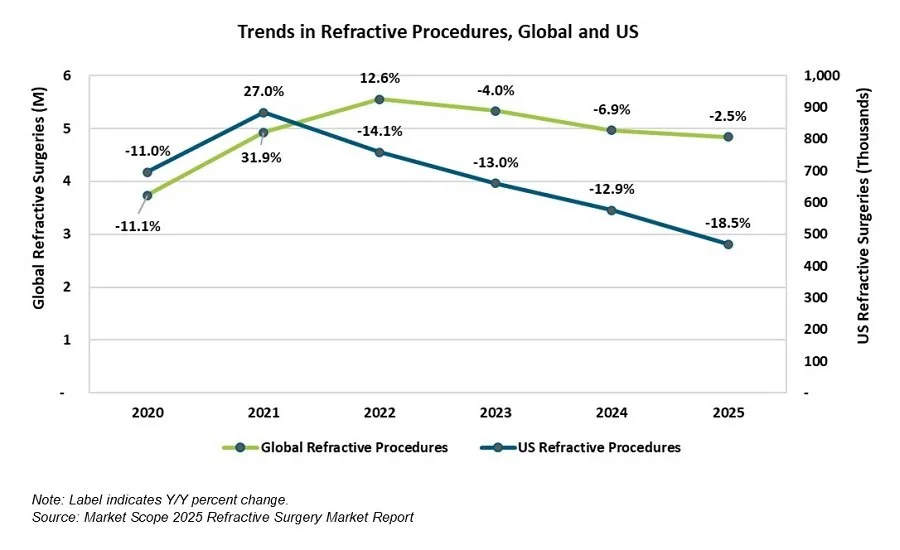
Laser vision correction volume in the United States officially fell to a record low in 2025, according to Market Scope, the industry's independent research firm. Its quarterly surgeon surveys put refractive procedures down 17.3% year over year in Q4 2025, and the slide has continued into 2026. A September 2026 report from STAAR Surgical puts the drop at 52% since 2022 – four straight years of double-digit losses.
This is a predictable spot for the LASIK industry to find itself in.
Two years ago, in a blog post on this website about the controversies with LASIK, I said that 2026 would be a pivotal year and that many LASIK centers in NYC and across the country would shutter or pivot to non-cutting procedures. I've been writing about why ”LASIK is dying” thanks to the LASIK-Industrial Complex for even longer.
But this record (25-year) low doesn't mean people have stopped wanting to get out of glasses and contacts.
Demand for vision correction hasn’t disappeared, but trust in LASIK has...
In that same STAAR survey, 86% of U.S. respondents (1,552 out of 1,800 glasses and contact lens wearers) concurred they want to be free of glasses and contacts. But 54% said they aren't open to laser correction.
Their top reasons? Safety concerns (27%) and fear of the procedure (21%). Cost came in at 4%.
So people aren't saying “no” to seeing clearly. They're saying no to having their cornea cut irreversibly.
When someone tells a survey they're afraid of laser eye surgery, what they're usually describing is LASIK – the flap, the dry eye, the horror stories they've read online. The laser was never the problem – the cutting is the problem.
How LASIK lost the public
This didn't happen overnight. A few things stacked up:
Social Media (specifically, the rise of TikTok’s “For You” algorithm and Instagram Reels). Patients started sharing negative experiences on camera, from Reddit threads to viral YouTubers and influencers.
The FDA spoke up. In 2022 it proposed a patient checklist of LASIK risks to walk through before surgery.
The FTC fined a major LASIK chain for bait-and-switch pricing ads – a symptom of what I call the "LASIK-Industrial Complex."
Gen Z does its homework. My average patient is about 26, and that generation trusts peer reviews over ads and also does A LOT of research on AI answer engines.
And now, you can add an Emmy to the list!
On October 17, Broken Eyes – Minnesota filmmaker Dana Conroy's documentary about her own LASIK complications – won an Upper Midwest Emmy® Award. The film aired on PBS stations and follows patients living with chronic dry eye, pain and flap complications.
Ten years ago, LASIK complications lived on message boards. Now they're the subject of an award-winning film on public television…
Most laser vision correction surgeons wouldn’t amplify this documentary by sharing it on their website. I have no concerns doing so. The issues examined in this film are unique to LASIK and do not apply to Advanced Surface Ablation (ASA).
The no-cut option already exists – it’s called ASA
I was a LASIK surgeon before I specialized in ASA. I made the switch for the same reason those survey respondents are hesitating: the flap is the flaw!
ASA uses the same excimer laser as LASIK, but no flap is ever cut. I gently loosen the corneal epithelium (the thin outer layer of cells) – no blade, no alcohol – and the laser reshapes the surface beneath it. The cornea stays structurally whole.
That removes flap-related risks entirely, including dislocation and epithelial ingrowth. It also spares more of the corneal nerves tied to post-LASIK dry eye.
The trade-off is time and healing. Functional vision returns in five to seven days, not overnight.
I ask patients a simple question: if you had two ways to do an elective procedure – one permanently alters the structure of your eye, the other leaves it intact and costs you a week – which would you pick? They usually answer it themselves.
What about ICL?
If LASIK is losing patients, where are they going? Some are choosing an implantable collamer lens (ICL) – a thin lens placed inside the eye, between the iris and your natural lens. STAAR, which makes the EVO ICL, reports its U.S. adoption up 76% since 2022.
ICL is a legitimate procedure, and for very high prescriptions it can be the right call. But for most people with mild-to-moderate nearsightedness, I think the comparison deserves a closer look.
ICL's big selling point is reversibility, and 61% of U.S. respondents in STAAR's survey said that appeals to them. I understand why. But "reversible" here means a second trip into the eye to take the lens out.
ASA never enters the eye at all. For a prescription in its range, that's a meaningful difference – and it's why I think the 54% who've ruled out "laser" deserve to hear that the problem was the flap, not the laser.
If your prescription is beyond ASA's range or your corneas are too thin, ICL is worth discussing with a lens specialist. Not sure where you fall? Start here.
So, is this the end of LASIK?
In a sense, it is. Because it is the end of LASIK as the default, automatic choice.
LASIK isn't going to vanish. There are skilled LASIK surgeons out there, and some patients will always want next-day vision. What's ending is the era when LASIK was the perfect answer for anyone tired of glasses – sold at volume, with the flap treated as a footnote.
Here's what I think comes next. The LASIK mills that depend on volume will keep closing or rebranding. The practices that last will lead with options that don't cut a flap – ASA for most prescriptions, and a lens for the highest ones.
Laser vision correction isn't dying. The flap is, and that’s a good thing.
The bottom line
LASIK's record low isn't the end of laser vision correction. It's the market finally catching up to what the flap costs.
If you're one of the 86% who want out of glasses and contacts but have written off laser surgery, the option you're looking for is the safest alternative to LASIK, and it's available today. You can compare all three procedures in ASA vs. LASIK vs. PRK, see what ASA costs, or book a free, no-pressure consultation in Manhattan.