
Tightening Lower Eyelids & Surrounding Skin with Radiofrequency
Here’s how we help patients look younger with a non-invasive, in-office procedure called OptiLIFT.

City living doesn't show your eyes and face any mercy. Long days on screens, harsh wind, up and down air quality, five hours of sleep more nights than you'd like to admit, and your eyes take the hit first. You can look tired on a genuinely good day, and it's often not even about sleep.
It's usually what's happening under the skin around your eyes: muscle tone and skin elasticity, which both fade with age whether you are well-rested or not.
I've written before about why OptiLIFT is a better, effectively risk-free alternative to blepharoplasty surgery for sagging lower lids. This summary goes one layer deeper, explaining what's actually happening during the brief and painless OptiLIFT procedure.
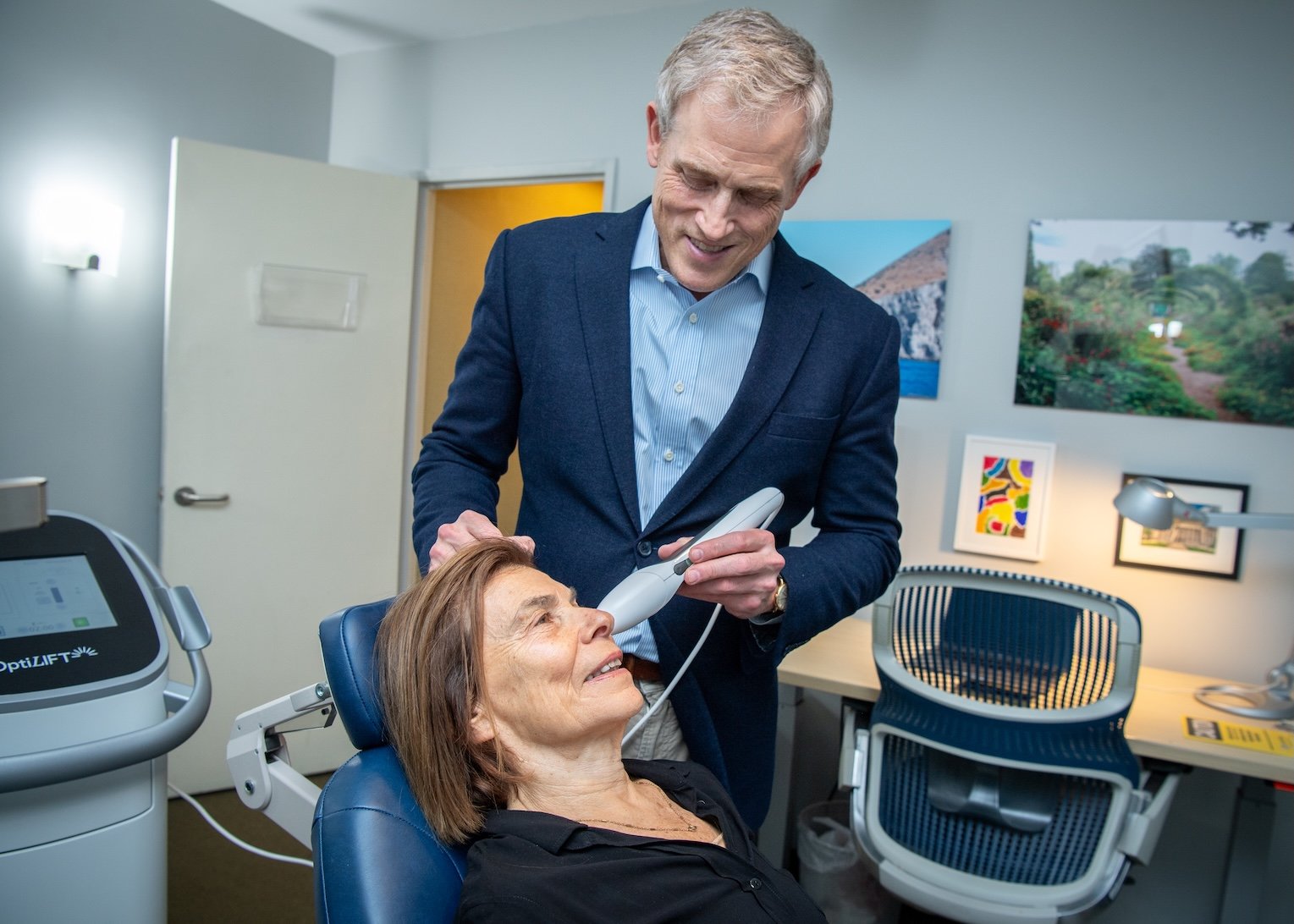
OptiLIFT Treats Two Types of Aging with Radiofrequency & Muscle Stimulation
Aging eyelids are really two separate problems wearing the same disguise.
First, the muscle. The orbicularis oculi, the ring of muscle that closes your eyelid, weakens with age like any muscle you stop training. A weaker muscle blinks less completely, and an incomplete blink is a major reason dry eye and eyelid laxity show up together so often in my patients.
Second, the skin. Collagen and elastin production slows starting in your mid-20s. By your 40s and 50s, the skin around the eyes – some of the thinnest skin on your body – loses its ability to spring back. That's what shows up as crepiness, sagging, and a permanent "just woke up" look.
Most treatments pick one problem and ignore the other. Fillers add volume but don't touch muscle function or collagen production. Surgery removes excess skin but doesn't strengthen the muscle underneath it. OptiLIFT is built to address both, in the same session.
The Radiofrequency (RF) Half
If you've looked into non-surgical skin tightening anywhere on the face, neck, or body, you've probably come across radiofrequency platforms like Thermi and XERF. They're popular for a reason: RF energy heats the deeper layers of skin, and your body reads that heat as a minor injury, responding by producing new collagen and elastin. Over the following weeks and months, treated skin tightens and firms.
That's the same underlying science OptiLIFT uses. The difference is how the energy gets there.
OptiLIFT delivers radiofrequency energy externally, through intact skin, with no needle and no anesthesia. It's a way gentler approach to the same science, which matters most exactly where the skin is thinnest and most sensitive.
The Muscle Stimulation Half
RF energy tightens skin. But on its own, it does nothing for the muscle underneath. That's where OptiLIFT's second technology, Dynamic Muscle Stimulation (DMSt), comes in.
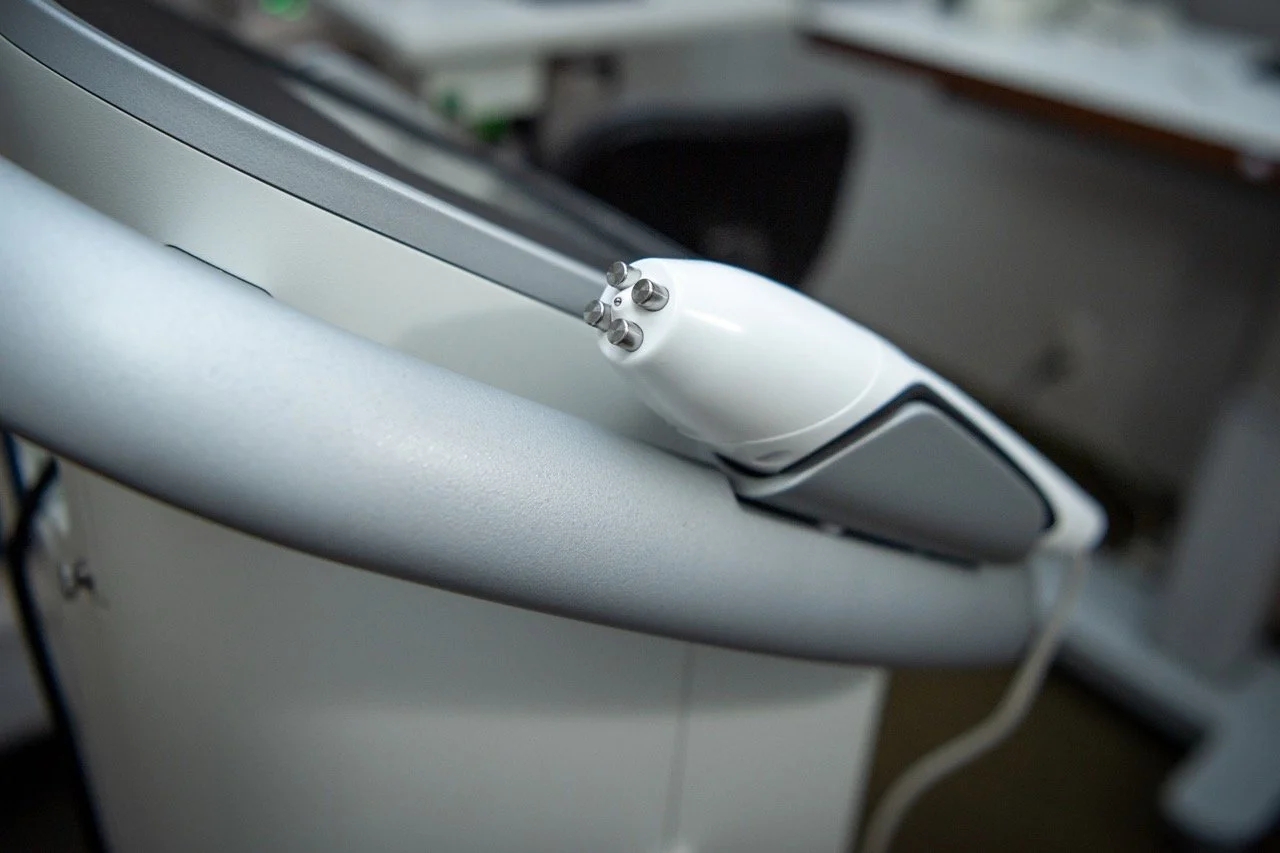
DMSt uses electrical pulses to trigger the nerves controlling the muscles around your eyes, causing them to contract – supervised training for a muscle you can't consciously exercise on your own. Over a course of sessions, that repeated contraction improves muscle tone, strengthens blink mechanics, and reduces the lower lid laxity that makes eyes look heavy or puffy.
A 2025 study in Clinical Ophthalmology measured DMSt applied to the periorbital area and found meaningful improvement in tear breakup time and blink quality, alongside a real reduction in lower lid laxity. That's the functional side. The cosmetic side – tighter, smoother, more awake-looking eyes – comes along with it, not as an afterthought.
OptiLIFT vs. XERF & Thermi, and the Rest of the RF Field in New York City
Radiofrequency isn't a new idea, and OptiLIFT isn't the only device using it. Two of the more established names patients ask me about are ThermiRF and XERF.
ThermiRF is minimally invasive: a thin probe goes under the skin through a needle puncture, monitored with a thermal camera, typically with local anesthesia. It's a strong option for the neck and jowls, where skin can tolerate that approach and the treatment area is larger.
XERF is a newer, genuinely non-invasive dual-frequency RF system, no needle involved, which puts it in the same invasiveness category as OptiLIFT. But it's a general face-and-body platform, built to reach down to the SMAS layer for jawline, cheek, and neck definition. It isn't designed for the periorbital area, has no applicator sized or calibrated for the eyelid, and does nothing for muscle tone or blink mechanics.
The same gap shows up with Thermage, Morpheus8, and most of the other RF names you'll see advertised: real technology, genuinely effective for what they're built for, and none of them purpose-built for the eye area or paired with muscle stimulation.
The point isn't that OptiLIFT beats these devices at their own job. It's that they're not doing OptiLIFT's job in the first place. If you want tighter jowls or a more defined jawline, ThermiRF or XERF are reasonable options to discuss with a qualified provider. If the concern is specifically your eyelids, blinking, and the skin immediately around your eyes, OptiLIFT is the one built for that anatomy.
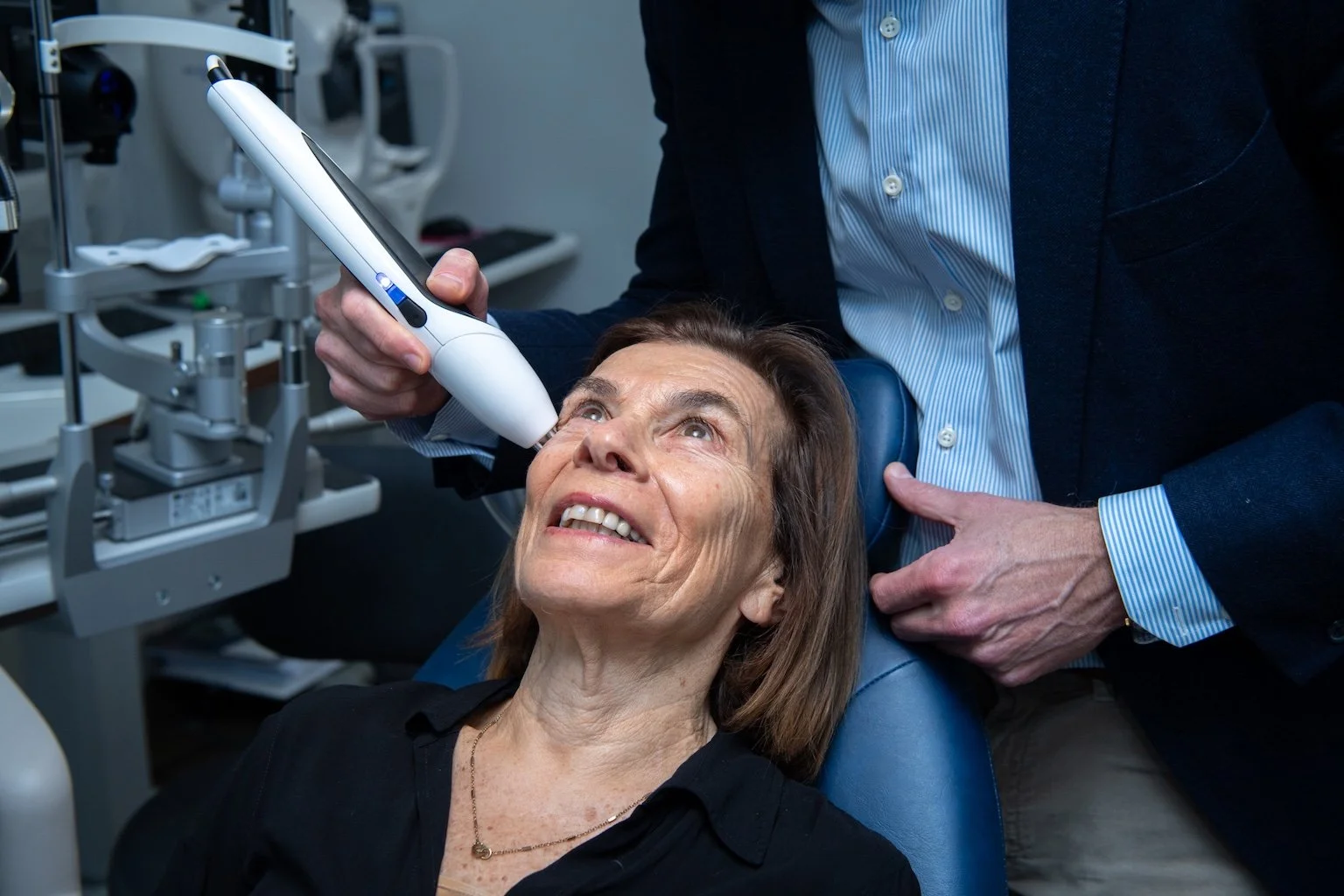
An Investment, Not a One-Time Fix
I’d never promise that a single round of OptiLIFT erases eyelid aging for good.
Aging doesn't stop, and nobody's device pauses it permanently. What I can say honestly is that every session moves you in the right direction, and there's essentially no downside to doing it: no needles, no incisions, no meaningful recovery, and one of the cleanest safety profiles in aesthetic medicine.
Click here to view Before & After photographs.
I advise patients to think of this treatment the same way they think about strength training or physical therapy: no single session is the whole answer, but every session you do makes a difference, and skipping it guarantees you lose ground faster. OptiLIFT is eyelid maintenance for people who'd rather stay ahead of the aging curve than wait for it to catch up.
Why This Fits Where Aesthetics Is Heading
The conversation around eye-area aging has shifted. High-definition cameras and constant video calls put every fine line under scrutiny most of us didn't ask for, and "hooded eyes" have become a genuine topic of mainstream conversation, not just a plastic surgeon’s.
At the same time, I think there's also a real move amongst New Yorkers away from the overfilled look and toward subtler, more natural results – treatments that enhance rather than announce themselves.
OptiLIFT DMS & RF Eyelid & Skin Treatment fits squarely into that shift. It isn't a dramatic before-and-after. It's a quieter, cumulative improvement – the kind where people notice you look rested, not that you had something done.
Who Should Consider It

OptiLIFT tends to be the right starting point for:
Mild to moderate lower lid laxity, or early Ptosis
Chronic dry eye tied to incomplete blinking
Crepey or puffy under-eye skin without excess skin requiring surgical removal
Anyone weighing blepharoplasty who'd rather try the least invasive option first
As with everything at our Upper East Side, NYC practice, from dry eye treatment to OptiLIGHT IPL, it's performed by me personally – not handed off to a technician. That's the same reasoning behind why I think an MD should be the one running any device this close to your eyes, radiofrequency included!
Where to Start
If your eyes look tired more often than you feel tired, a consultation is the fastest way to find out whether OptiLIFT, another treatment, or a combination makes sense for you.