
Punctal Plugs vs. IPL for Dry Eye
Here’s why we recommend Light Therapy for most New Yorkers
There's a version of dry eye care that most patients experience: you mention your symptoms, you get handed plugs or a bottle of artificial tears, and you leave thinking the problem is solved.
I've placed punctal plugs for years and we still offer them at Moskowitz Eye Care in NYC.
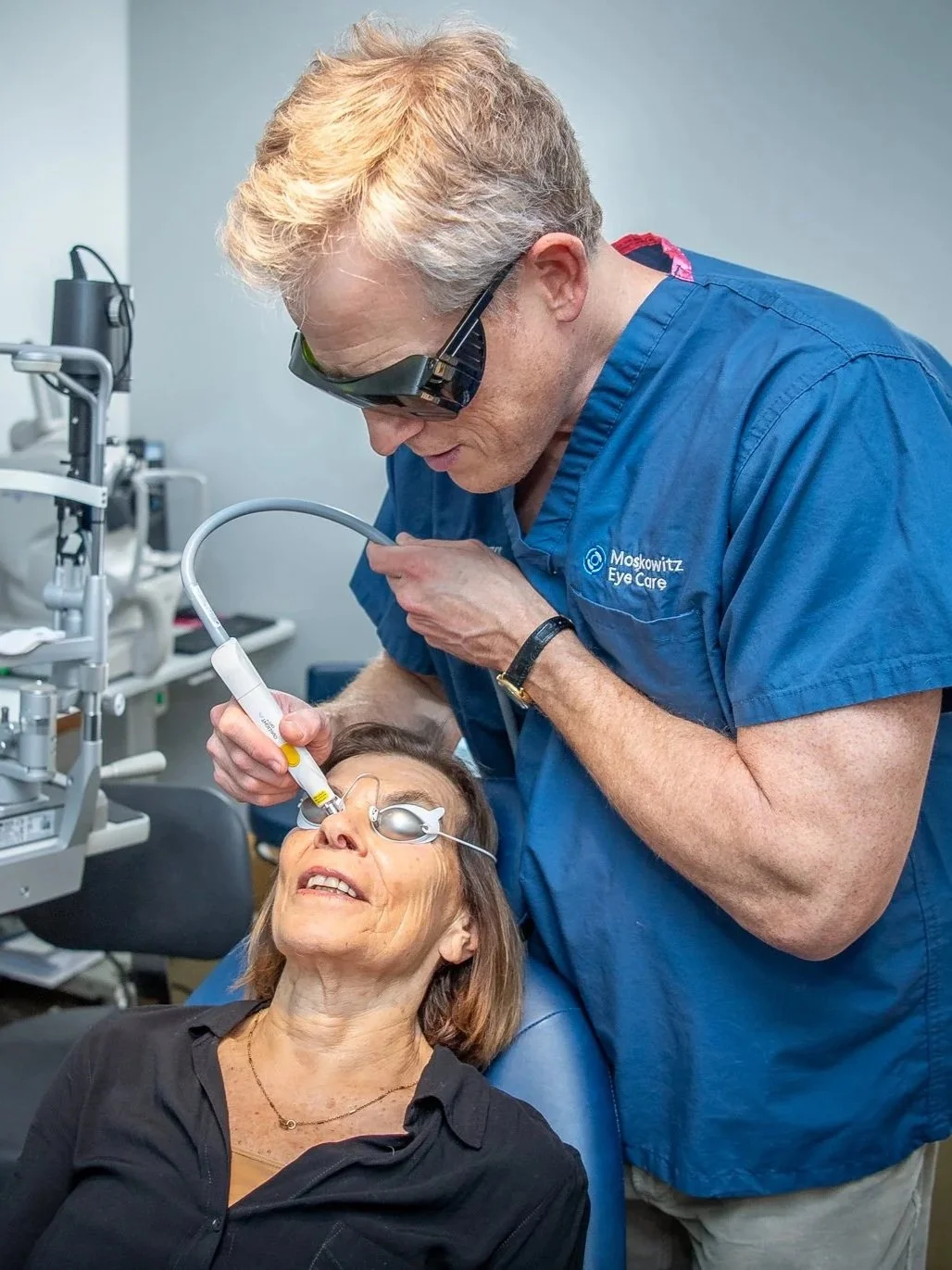
But I want to be honest with you about what they actually do — and why, for the right candidate, OptiLIGHT IPL is the more meaningful upgrade.
What Punctal Plugs (aka Tear Duct Plugs) Actually Do
Punctal plugs are tiny devices inserted into the tear ducts (the small openings at the inner corners of your eyelids) to slow the drainage of tears off the surface of the eye. The logic is straightforward: keep more tears on the eye, and the eye stays more comfortable.
And it works… to a point!
The problem is that plugs don't care what kind of tears are being retained. When the underlying issue is Meibomian Gland Dysfunction (MGD) — which drives the majority of chronic dry eye cases — the tears your eye is producing are already compromised. The oil layer is deficient. The tears evaporate too quickly and lack the quality needed to properly protect and nourish the ocular surface.
Plugs trap those low-quality tears in place. You're essentially bottling up a suboptimal product and calling it a solution.
There's also a practical side to this: plugs can fall out, cause irritation, or require follow-up to replace or adjust. They're a management tool, not a corrective one.
A Specific Risk: Plugs Can Worsen Ocular Rosacea and MGD
There's something that doesn't come up often enough in typical dry eye conversations: for patients with ocular rosacea (which is far more common than most people realize) punctal plugs don't just fall short – they can actively make things worse.
Here's the mechanism: ocular rosacea drives chronic inflammation along the eyelid margins, progressively blocking the meibomian glands and causing them to produce thickened, stagnant secretions. When plugs slow tear drainage, they also slow the clearance of inflammatory mediators – cytokines, oxidized lipids, bacterial byproducts – that have accumulated on the ocular surface. Rather than washing away, those irritants linger. You're not preserving a healthy tear environment. You're concentrating an unhealthy one.
Patients with active MGD and underlying rosacea who rely on plugs often see their redness, eyelid swelling, and gland dysfunction worsen over time. The device meant to bring comfort ends up feeding the inflammatory cycle it was supposed to calm.
This is one of the more counterintuitive things I explain at consultations, and it's exactly why I evaluate the cause of a patient's dry eye carefully before reaching for a plug.
What IPL Does Differently
As I've written about when comparing OptiLIGHT to newer prescription drops like Miebo and Xdemvy, the distinguishing feature of IPL is that it treats the source of the dysfunction (not the downstream symptoms).
OptiLIGHT IPL uses controlled pulses of light applied to the skin beneath the eyes to do several things at once:
Open blocked meibomian glands, restoring the eye's natural ability to produce a healthy lipid layer
Reduce eyelid and periocular inflammation, which is often perpetuating the cycle of dysfunction
Eliminate abnormal blood vessels associated with ocular rosacea, a frequently overlooked contributor to dry eye
Reduce or eradicate Demodex mite populations, one of the most common causes of chronic eyelid inflammation and blepharitis
The result isn't just "more tears" — it's better tears.
Your eye learns to produce a more complete, stable tear film on its own again. That's a fundamentally different outcome than what a plug can offer.
So Why Do We Still Offer Plugs?
Because not every patient is a candidate for IPL, and not every situation calls for the same tool!
We take a conservative, individualized approach here — I describe this philosophy in our dry eye treatment overview.
Punctal plugs still have a role: for patients with certain anatomical considerations, for those who aren't candidates for light-based treatments, or as part of a broader management plan while other treatments take hold.
But if you're a good candidate for IPL and you've been told plugs are your only option — I'd encourage you to ask more questions. There's a reason we've built our dry eye clinic around OptiLIGHT and OptiLIFT: it's simply the most effective, durable tool we have for treating the underlying disease, not just its surface-level effects.
Ready to Treat the Cause?
You deserve eyes that work the way they're supposed to. If your dry eye symptoms persist despite plugs, drops, or artificial tears, it may be time to look upstream!
Live in NYC? Schedule a consultation by clicking the button below and we'll evaluate whether OptiLIGHT is the right next step for your eyes, your lifestyle, and your goals.